How Much Loan EMI Can You Afford? The FOIR Framework Explained
Banks use FOIR (Fixed Obligation to Income Ratio) to decide your maximum EMI. Here's exactly how it works, what your lender's limit is, and how to maximize your loan eligibility without overextending.
Key Takeaways
- Most Indian banks cap FOIR at 40–50% of gross monthly income for home loans. Some go up to 55–60% for high-income borrowers.
- FOIR includes ALL existing EMIs — credit card minimums, personal loans, car loans — not just the new loan you're applying for.
- Your stated eligibility and what you can comfortably afford are often different numbers. Target 35–40% FOIR for financial resilience.
- Closing an existing EMI before applying significantly boosts your home loan eligibility.
Every home loan sanction starts with a single calculation the bank doesn't always show you: FOIR. Fixed Obligation to Income Ratio is the bank's answer to "how much can this person safely pay every month?" — and it determines both whether you get the loan and how large it can be.
Understanding FOIR lets you predict your eligibility before you walk into a bank, optimize your finances to maximize the loan amount, and — equally importantly — avoid borrowing more than you can actually sustain. Use our loan eligibility calculator to see your maximum eligible loan amount based on your income and existing obligations.
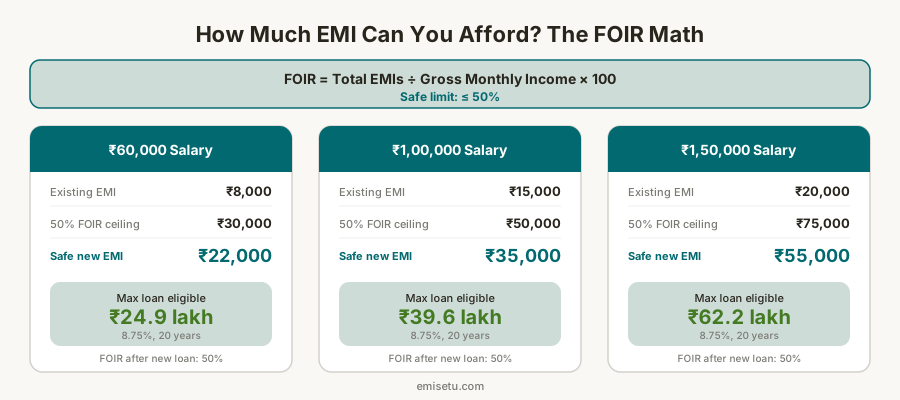
What Is FOIR?
FOIR = Total Fixed Monthly Obligations ÷ Gross Monthly Income × 100
"Fixed obligations" include every committed monthly payment:
- All existing loan EMIs (personal loan, car loan, education loan, other home loans)
- Minimum credit card payments (banks typically take 5% of outstanding balance or the minimum due)
- Any formal rent obligations (if relevant to underwriting)
- The proposed new loan's EMI
"Income" is typically gross monthly income (before tax) for salaried employees, or average net monthly profit for self-employed borrowers.
Example calculation
Salaried borrower, monthly gross income: ₹1,20,000
Existing obligations:
- Car loan EMI: ₹18,000
- Personal loan EMI: ₹8,000
- Credit card minimum (₹2,000 assumed): ₹2,000
- Proposed home loan EMI: ?
Current FOIR without new loan = (₹18,000 + ₹8,000 + ₹2,000) / ₹1,20,000 = 23.3%
If bank's FOIR cap = 50%, then maximum new EMI = 50% × ₹1,20,000 − ₹28,000 = ₹32,000
At 9% for 20 years, ₹32,000 EMI supports a loan of approximately ₹35.5 lakh.
FOIR Limits at Major Indian Banks
Banks set their own FOIR thresholds, and these vary by income level, employment type, and credit profile:
| Lender | FOIR Cap (Salaried) | FOIR Cap (Self-Employed) | Notes |
|---|---|---|---|
| SBI | 50–55% | 45–50% | Higher for incomes above ₹1.5L/month |
| HDFC Bank | 50% | 45% | Up to 60% for high income profiles |
| ICICI Bank | 50–55% | 45% | Step-up loans allow slightly higher |
| Axis Bank | 50% | 45–50% | Negotiable for premium profiles |
| LIC Housing | 45% | 40–45% | Conservative underwriting |
| Most NBFCs | 55–65% | 50–55% | More flexible but higher rates |
For incomes above ₹3 lakh/month, some lenders stretch the FOIR cap to 60–65%, reasoning that even at 60% FOIR, a ₹3 lakh earner has ₹1.2 lakh residual income — well above minimum living expenses.
How to Calculate Your Maximum Eligible Loan Amount
Step 1: Determine your available EMI budget
Available EMI = (FOIR cap × Gross monthly income) − All existing obligations
For ₹1,00,000 gross income, 50% FOIR cap, ₹15,000 existing EMIs: Available EMI = (50% × ₹1,00,000) − ₹15,000 = ₹35,000
Step 2: Convert EMI budget to loan amount
Use the reverse EMI formula or our home loan EMI calculator:
At 9% rate, 20-year tenure: ₹35,000 EMI → ~₹38.9 lakh loan At 8.5% rate, 20-year tenure: ₹35,000 EMI → ~₹40.3 lakh loan At 9% rate, 25-year tenure: ₹35,000 EMI → ~₹41.7 lakh loan
Rate and tenure both significantly affect your eligible amount.
Maximum eligible loan by income — quick reference
At 9% rate, 20-year tenure, 50% FOIR, no existing obligations:
| Gross Monthly Income | Max EMI (50% FOIR) | Max Loan Eligible |
|---|---|---|
| ₹50,000 | ₹25,000 | ₹27.8 lakh |
| ₹75,000 | ₹37,500 | ₹41.7 lakh |
| ₹1,00,000 | ₹50,000 | ₹55.6 lakh |
| ₹1,50,000 | ₹75,000 | ₹83.4 lakh |
| ₹2,00,000 | ₹1,00,000 | ₹1.11 crore |
| ₹3,00,000 | ₹1,50,000 | ₹1.67 crore |
These figures assume no existing obligations. Each ₹10,000 in existing EMIs reduces eligibility by approximately ₹11–12 lakh (at 9%, 20 years).
The Difference Between Eligible and Affordable
Banks will tell you how much you can borrow. They rarely tell you how much you should borrow.
Your bank's 50% FOIR cap is the maximum — not the recommendation. Borrowing to the maximum FOIR limit leaves you with:
- No buffer for job loss, medical emergencies, or income disruption
- Very limited capacity to save or invest for other goals
- High financial stress that research shows persists for the entire loan tenure
The 35% rule: For long-term financial resilience, keep your total debt obligations (all EMIs combined) below 35% of gross income. This leaves 65% for taxes, living expenses, savings, and investments.
What different FOIR levels mean in practice
| FOIR | Assessment | Practical Reality |
|---|---|---|
| Under 30% | Excellent | Strong surplus for savings, emergencies |
| 30–40% | Good | Comfortable, some surplus |
| 40–50% | Acceptable | Manageable but tight |
| 50–60% | Stressed | Very little surplus; any income disruption is serious |
| Above 60% | Dangerous | One unexpected expense can trigger default |
Strategies to Maximize Your Home Loan Eligibility
1. Close existing EMIs before applying
The most impactful lever. A ₹10,000 car loan EMI that you can prepay in full (say ₹2.5 lakh outstanding) immediately adds ₹10,000 to your available EMI budget — unlocking approximately ₹11 lakh more in home loan eligibility.
Run the numbers: if prepaying the car loan releases ₹11 lakh in home loan eligibility, and you need that eligibility to buy your target property, the prepayment may be worth it.
2. Add a co-applicant
A co-applicant (typically a spouse or parent) allows their income to be combined with yours for FOIR calculation. A couple with ₹80,000 + ₹60,000 income is assessed as ₹1,40,000 gross income, significantly boosting eligibility.
Most banks accept the following co-applicants: spouse, parents (age limit applies — typically the co-applicant must be below 65 at loan maturity), adult children.
3. Extend tenure to 25 or 30 years
A longer tenure reduces the monthly EMI, which reduces the FOIR consumed by the new loan. For the same loan amount, extending tenure from 20 to 25 years reduces EMI by approximately 8–10%.
Trade-off: A 25-year loan pays significantly more total interest than a 20-year loan — about 25–30% more. Use tenure extension to maximize eligibility if needed, but prepay aggressively.
4. Improve your credit score
Some lenders stretch their FOIR cap by 5–10 percentage points for borrowers with CIBIL scores above 800. A 780 borrower who improves to 810+ before applying may gain access to a higher FOIR cap.
5. Opt for step-up EMI schemes
Certain banks offer step-up (also called balloon) home loans where the initial EMI is lower and increases over time. This allows a higher loan amount at a lower initial FOIR, with the assumption that income will grow to support the rising EMI. Use our step-up EMI calculator to model how rising EMI instalments affect your total interest cost and eligibility.
Frequently Asked Questions
What is FOIR in home loans?
FOIR stands for Fixed Obligation to Income Ratio. It is the ratio of all monthly fixed financial obligations (existing EMIs, credit card minimums, and the proposed new EMI) to your gross monthly income. Banks use it to assess how much of your income is committed to debt repayment and whether you can comfortably handle a new loan.
What FOIR percentage is ideal for a home loan?
Banks typically allow up to 50% FOIR. But for personal financial health, keeping total FOIR below 35% is recommended — it leaves sufficient income for savings, investments, and emergencies.
How can I increase my home loan eligibility?
You can increase eligibility by: (1) prepaying or closing existing loans before applying, (2) adding an income-earning co-applicant, (3) extending the loan tenure, (4) improving your CIBIL score to unlock higher FOIR caps, or (5) opting for step-up EMI schemes.
Does credit card debt affect home loan eligibility?
Yes. Banks include credit card minimum dues (typically 5% of the outstanding balance) in your fixed obligations for FOIR calculation. If you carry a ₹2 lakh credit card balance, banks may count ₹10,000 (5%) as a fixed monthly obligation. Clear credit card outstanding before a home loan application.
Can I get a home loan with 50% FOIR?
Yes — most banks sanction loans up to 50% FOIR for salaried borrowers. Some lenders go higher for high-income profiles. However, 50% FOIR is financially stressful; aim for 35–40% for comfortable repayment.
How is FOIR calculated for self-employed borrowers?
For self-employed borrowers, lenders typically use the average of the last 2–3 years' net profit (after tax, per ITR) as the income figure. Some lenders use gross income. The FOIR cap for self-employed is usually 5–10% lower than for salaried borrowers because of perceived income variability.
Try the calculator
Run your own numbers in seconds. Pick the calculator that fits your loan type.