Home Loan for Self-Employed in India — The Complete 2026 Playbook
Self-employed borrowers face a harder home loan process — higher rates, more documents, and stricter underwriting. Here's exactly what banks check, which lenders are most SE-friendly, and how to maximise your loan amount.
Key Takeaways
- Self-employed borrowers typically pay 25–50 bps more than salaried borrowers for the same loan. LIC Housing Finance and Bajaj Housing are the most SE-friendly lenders.
- Banks assess income from the average of last 2–3 years' net profit (post-tax, per ITR) — plus depreciation added back.
- Declining ITR profit over consecutive years is the #1 reason self-employed home loan applications are rejected.
- A business vintage of 3+ years with clean ITRs is the minimum threshold. 5+ years significantly improves approval odds.
India has over 6.3 crore registered MSMEs and tens of millions of self-employed professionals — doctors, lawyers, architects, freelancers, traders, and business owners. Yet home loan underwriting in India was historically built around salaried employment. While the landscape has improved significantly since 2018, self-employed borrowers still navigate a meaningfully different process.
Understanding this process — the documents, the income calculation methodology, the right lenders, and the common rejection triggers — is the difference between approval and rejection.
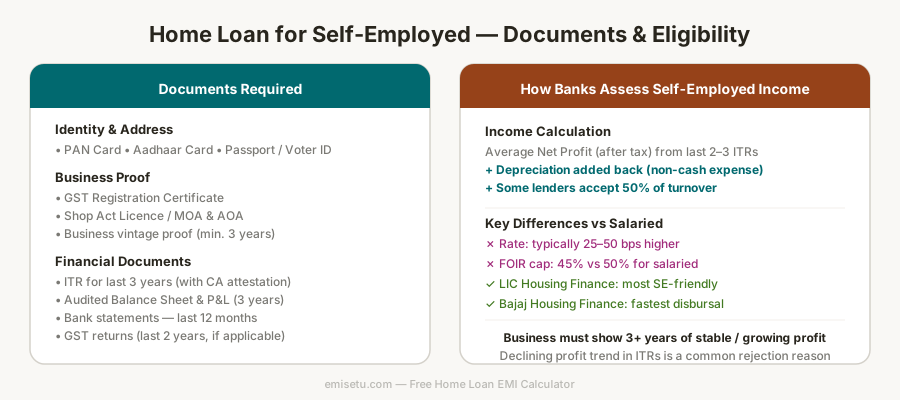
How Banks Assess Self-Employed Income
The fundamental challenge for self-employed borrowers is income verification. Without a salary slip or Form 16, banks rely on financial statements and tax returns:
The income formula banks use
Assessed annual income = Average Net Profit (per ITR) + Depreciation (added back)
Depreciation is a non-cash accounting expense that reduces stated profit without actually reducing cash available for repayment. Most banks add it back to arrive at a higher "repayment capacity" income.
Example:
- Year 1 net profit (ITR): ₹12 lakh; Depreciation: ₹1.5 lakh
- Year 2 net profit (ITR): ₹14 lakh; Depreciation: ₹1.8 lakh
- Year 3 net profit (ITR): ₹16 lakh; Depreciation: ₹2.2 lakh
Average assessed income = [(12 + 1.5) + (14 + 1.8) + (16 + 2.2)] / 3 = ₹15.83 lakh/year = ₹1.32 lakh/month
At 45% FOIR cap: maximum eligible EMI = ₹1.32L × 45% = ₹59,400/month
At 9%, 20 years: this supports a loan of ~₹66 lakh. Use our loan eligibility calculator to calculate your own maximum loan amount based on assessed income and existing obligations.
Profit trend matters more than the average
Banks assess the trend, not just the average. Three consecutive years of growing profit signals business stability. Declining profits — even if Year 3 is still high — raise underwriting red flags about sustainability.
Positive trend (strong application):
- Year 1: ₹10L → Year 2: ₹13L → Year 3: ₹16L ✓
Declining trend (rejection risk):
- Year 1: ₹18L → Year 2: ₹14L → Year 3: ₹11L ✗
Documents Required
Identity and KYC
- PAN Card (mandatory)
- Aadhaar Card (mandatory)
- Passport or Voter ID (one of the above for address proof)
- Photographs
Business existence proof
- GST Registration Certificate (threshold: ₹20 lakh for service providers; ₹40 lakh for goods suppliers in most states)
- Shop Act Licence / Trade Licence / Municipal Certificate
- Memorandum of Association (MOA) and Articles of Association (AOA) for Pvt. Ltd./Ltd. companies
- Partnership deed (for partnership firms)
- Udyam Registration Certificate (MSME registration)
Financial documents
- Income Tax Returns (ITR) for last 3 financial years — with CA attestation
- Audited Balance Sheet and Profit & Loss Account for last 3 years
- CA Certificate for income (at many lenders)
- Bank statements — last 12 months for all business and personal accounts
- GST returns — last 8 quarters (where applicable)
Property documents (standard for all borrowers)
- Sale agreement / title deed
- Approved building plan
- Occupancy Certificate / Completion Certificate
- Property tax receipts (last 2 years)
The Lender Landscape — Most SE-Friendly Options
Not all lenders treat self-employed borrowers equally. Some have built dedicated underwriting capabilities; others apply rigid salaried frameworks.
| Lender | SE Rates | SE FOIR Cap | Key Advantage |
|---|---|---|---|
| LIC Housing Finance | 8.80–9.85% | 50% | Most SE-friendly; accepts varied income structures |
| Bajaj Housing Finance | 8.50–10.25% | 55% | Fastest disbursal; accepts bank statement income |
| SBI | 8.65–9.90% | 45% | Lowest rate; slow and document-heavy |
| HDFC Bank | 8.95–10.10% | 45% | Good for established businesses; strict trend requirement |
| Axis Bank | 9.00–10.50% | 45% | Negotiable; RM-dependent outcome |
| PNB Housing Finance | 8.75–10.25% | 50% | Good for SE; accepts declared income in some cases |
| Tata Capital Housing | 8.85–10.50% | 50% | Accepts bank statement average for cash-heavy businesses |
Rates shift with RBI repo changes — verify current home loan rates for self-employed borrowers before approaching any lender to confirm the latest starting rate for your profile.
Why LIC Housing Finance? LICHFL's underwriting team has decades of experience with non-standard income profiles. They assess cash flows more holistically than pure ITR-based banks, and their FOIR cap of 50% matches salaried borrowers — uncommon in the SE space.
Common Rejection Reasons and How to Fix Them
1. Declining profit trend in ITRs
Problem: Banks see risk in a declining profit trajectory even if current profits are healthy.
Fix: Wait 1–2 additional ITR cycles showing growth before applying. If the decline was driven by a specific one-time factor (COVID impact, a lost client, expansion costs), prepare a CA explanation letter documenting the reason and recovery.
2. Significant gap between ITR income and bank deposits
Problem: If your bank deposits are ₹50 lakh/year but ITR shows ₹8 lakh profit, banks question whether undeclared income is being relied upon for repayment.
Fix: Declare income accurately in ITRs. This is a multi-year fix — but it's the right one both legally and for loan eligibility.
3. Business vintage under 3 years
Problem: Most banks require minimum 3 years of business operation. Newer businesses — even highly profitable ones — are considered high risk.
Fix: Apply to Bajaj Housing Finance or fintech lenders who accept 2-year vintage, at higher rates. Or wait until the 3-year threshold is crossed.
4. Poor personal CIBIL score despite strong business
Problem: Self-employed borrowers sometimes prioritise business credit over personal credit, leading to personal CIBIL in the 650–720 range.
Fix: Improve personal CIBIL by 3–6 months of credit card management (utilisation below 30%, all payments on time). See our CIBIL improvement guide.
How to Calculate Your Home Loan Eligibility as Self-Employed
Using our loan eligibility calculator:
- Calculate your assessed monthly income (average ITR net profit + depreciation ÷ 12)
- Apply the lender's FOIR cap (use 45% as a conservative estimate)
- Subtract existing EMIs from the FOIR headroom
- The remaining amount is your maximum eligible monthly EMI
- Enter this EMI, rate (use 9.25% for self-employed), and tenure (up to 20 years) in the home loan EMI calculator to find your maximum loan amount
Example: Assessed income ₹1.5 lakh/month, existing car loan EMI ₹12,000.
- Available EMI at 45% FOIR = ₹67,500 − ₹12,000 = ₹55,500
- At 9.25%, 20 years: Maximum loan ≈ ₹60.6 lakh
Frequently Asked Questions
Can I get a home loan without ITR as a self-employed person?
Difficult through mainstream banks. Some NBFCs (Bajaj Housing Finance, Tata Capital) accept bank statement-based income assessment for applicants who don't file ITR — but rates are higher (10–12%) and LTV is capped at 65%. Filing accurate ITRs is strongly advisable for long-term financial health and better loan eligibility.
Which bank gives the easiest home loan for self-employed?
LIC Housing Finance and Bajaj Housing Finance consistently get cited as the most self-employed friendly for home loans. They accept more varied income structures, have slightly more flexible underwriting, and process applications with dedicated SE teams.
How many years of ITR do I need for a home loan?
Most banks require 3 years. Some (SBI, HDFC) may require the last 2 years for professionals (doctors, CAs, lawyers) with established practices. For trading or manufacturing businesses, 3 years is the standard minimum.
Can a freelancer get a home loan in India?
Yes, but with more difficulty. Freelancers are treated as self-employed professionals. The key requirements: 2–3 years of consistent income evidence (ITRs, bank statements showing regular client payments), CIBIL 750+, and ideally registrations (GST, professional body memberships) that establish business legitimacy. HDFC Credila and some fintech lenders have more experience with freelancer/gig economy income profiles.
Will a business loan on my company's balance sheet affect my personal home loan eligibility?
Business loans in the company's name (not personal guarantee) typically don't affect personal FOIR. However, if you've given a personal guarantee on the business loan, the lender may include it in FOIR assessment. Always clarify this with the home loan underwriter upfront.
Try the calculator
Run your own numbers in seconds. Pick the calculator that fits your loan type.