Gold Loan Interest Rates India 2026 — LTV Rules & Lender Comparison
Gold loan rates range from 8.5% to 26% on the same gold — LTV, valuation, and repayment type decide your real cost. Here is the complete guide for 2026.
Key Takeaways
- RBI caps loan-to-value (LTV) on gold loans at 75% — but under the RBI Lending Against Gold and Silver Collateral Directions, 2025 (effective April 1, 2026), accrued interest now counts toward that 75% cap, slightly reducing the cash you receive upfront.
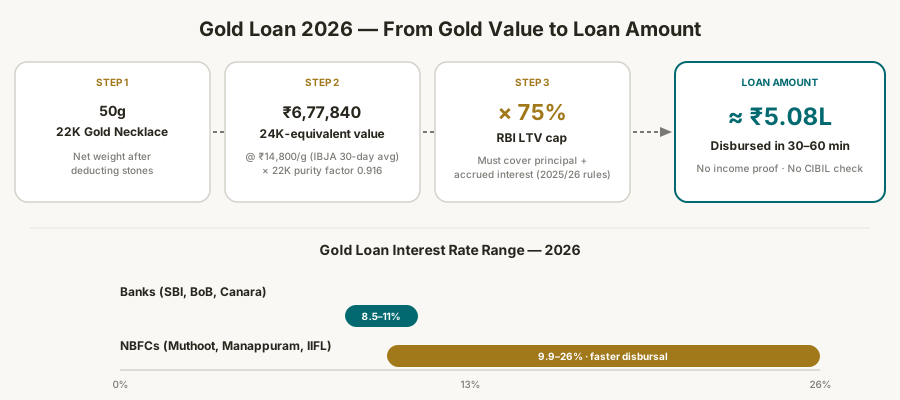
- Bank gold loans (SBI, BoB, Canara) run 8.5%–11%; NBFC gold loans (Muthoot, Manappuram, IIFL) run 11%–26% — but NBFCs disburse in 30 minutes with zero income proof.
- Your loan amount is driven by gold purity (karat) and weight, not the piece's market or sentimental value — only the gold content is valued.
- Bullet repayment (pay all interest + principal at maturity) suits short-term needs; EMI schemes suit borrowers who want predictable monthly outflow without a lump sum at the end.
- Missing payments doesn't just hurt your CIBIL score — after a notice period, the lender can auction your gold to recover dues.
A gold loan is the only retail credit product in India where your CIBIL score, income proof, and employment history are almost irrelevant. Walk into a branch with gold jewellery or coins, and most lenders will disburse funds to your account within an hour. That speed and accessibility make gold loans the go-to choice for emergencies, business working capital, and bridging cash-flow gaps.
But "fast" doesn't mean "cheap" — and the rate gap between lenders is enormous. This guide breaks down exactly how gold loan pricing works in 2026, what changed under RBI's latest gold-lending rules, and how to compare offers so you don't overpay for a loan against your own asset.
How a Gold Loan Works
A gold loan is a secured loan — you pledge gold jewellery, coins, or bars as collateral, and the lender disburses a percentage of its assessed value as a loan. The lender holds your gold in a secure vault for the loan tenure and returns it once you repay in full.
The process, end to end:
- Valuation — the lender's in-house assayer tests the purity of your gold (typically via a touchstone or XRF machine) and weighs only the gold content, excluding stones, beads, or other metals.
- Loan offer — based on the current gold rate, purity, and net weight, the lender calculates the gold's value and offers a loan up to the permitted LTV.
- Documentation — basic KYC (Aadhaar, PAN) and a loan agreement. No income proof, salary slips, or CIBIL check for most schemes.
- Disbursal — funds are credited to your bank account, often within 30–60 minutes.
- Repayment — depending on the scheme (EMI, bullet, or overdraft), you repay principal and interest over the tenure (typically 3 months to 3 years).
- Gold release — once the loan is closed, your gold is returned, verified against the original pledge receipt.
RBI's Gold Loan Rules in 2026 — LTV, Valuation & What Changed
The Reserve Bank of India regulates gold loans primarily through the loan-to-value (LTV) ratio — the maximum percentage of your gold's value that can be disbursed as a loan.
| Rule | Detail |
|---|---|
| Maximum LTV | 75% of the assessed value of gold collateral |
| What counts in LTV | Principal and accrued interest must stay within 75% over the loan tenure (RBI Lending Against Gold and Silver Collateral Directions, 2025, effective April 1, 2026) |
| Valuation standard | Gold must be valued at the average of the closing price over the preceding 30 days, using rates published by IBJA (India Bullion and Jewellers Association) |
| Eligible collateral | Gold jewellery, coins (up to specified weight limits), and bullion — primary gold/silver bars are restricted for certain schemes |
| Re-pledge restrictions | Lenders cannot accept gold that is already pledged elsewhere, and must verify ownership |
| Auction process | Borrower must be given adequate notice before auction; the gold must be auctioned transparently, and any surplus after recovering dues must be returned to the borrower |
Why the 2025/2026 rules matter for you: Earlier, many lenders calculated the 75% LTV only on the principal disbursed at the start — interest accrued over the tenure could push the total outstanding well past 75% of the gold's value by the time you repaid, especially on bullet-repayment loans. The revised framework requires lenders to monitor LTV on a running basis (principal + accrued interest), which means bullet loans now often disburse a slightly lower upfront amount than they used to, to leave headroom for interest accrual. EMI-based loans, where interest is paid monthly and doesn't accumulate, are less affected.
Gold Loan Interest Rates 2026 — Bank vs NBFC Comparison
| Lender | Interest Rate (p.a.) | Max LTV | Processing Time | Best For |
|---|---|---|---|---|
| State Bank of India | 8.70%–9.90% | 75% | 1–2 days | Lowest rate, slower disbursal |
| Bank of Baroda | 8.90%–10.50% | 75% | 1–2 days | Competitive rate, branch-dependent |
| Canara Bank | 9.25%–11.00% | 75% | 1–2 days | Wide branch network |
| HDFC Bank | 9.30%–17.55% | 75% | Same day | Fast for existing customers |
| ICICI Bank | 10.00%–19.00% | 75% | Same day | Digital top-up options |
| Muthoot Finance | 9.96%–24.00% | Up to 75% | 30–60 minutes | Fastest, largest gold loan network |
| Manappuram Finance | 9.90%–26.00% | Up to 75% | 30–60 minutes | Flexible schemes, doorstep options |
| IIFL Finance | 10.50%–24.00% | Up to 75% | 30–60 minutes | Digital gold loans, app-based renewal |
Why such a wide range within the same lender? Most lenders run multiple "schemes" — a low-rate, low-LTV scheme for borrowers prioritising cost, and a high-rate, high-LTV (or longer tenure / bullet) scheme for borrowers prioritising loan amount and convenience. Always ask which scheme you've been quoted, and whether a lower-rate scheme is available for the same LTV.
Banks are consistently cheaper than NBFCs because they have lower cost of funds and stricter underwriting — but NBFCs win on speed, branch density (especially in semi-urban and rural India), and willingness to lend against smaller quantities of gold. For the latest bank gold loan rates, check our loan rates page.
How Your Loan Amount Is Calculated
Your loan amount depends on three things: purity, weight, and the current gold rate — never the jewellery's design, brand, or sentimental value.
Step 1 — Net gold weight. The lender weighs your jewellery and deducts the weight of stones, beads, enamel, or other non-gold materials. A 50-gram necklace with 5 grams of stones is valued as 45 grams of gold.
Step 2 — Purity adjustment. Gold purity is expressed in karats. 24K is 99.9% pure; 22K (the most common for Indian jewellery) is ~91.6% pure; 18K is 75% pure. The lender converts your net weight to its 24K-equivalent value.
Step 3 — Apply the IBJA rate. The lender uses the 30-day average gold rate (per gram, 24K) published by IBJA — not today's spot rate, and not the rate printed on your jewellery's bill.
Step 4 — Apply LTV. Multiply the gold's assessed value by up to 75%.
Worked example
Assume you pledge a 50-gram, 22K gold necklace, and the IBJA 30-day average 24K rate is ₹14,800/gram.
| Step | Calculation | Result |
|---|---|---|
| Net gold weight | 50g (assume no stones) | 50g |
| 24K-equivalent value | 50g × ₹14,800 × (22K ÷ 24K purity factor ≈ 0.916) | ₹6,77,840 |
| Maximum loan at 75% LTV | ₹6,77,840 × 75% | ≈ ₹5,08,380 |
Lenders typically round down and apply scheme-specific caps, so expect an actual offer of around ₹4.95–5.05 lakh for this example. Gold prices move daily — re-run this calculation with the current IBJA rate before visiting a branch, and use the gold loan EMI calculator to model the repayment for any EMI-based scheme.
Types of Gold Loan Repayment — EMI, Bullet & Overdraft
| Repayment Type | How It Works | Best For | Watch Out For |
|---|---|---|---|
| EMI (term loan) | Fixed monthly payment covering principal + interest, like a regular loan | Borrowers who want predictable budgeting and a clear end date | Slightly higher rate than bullet schemes at some lenders |
| Bullet repayment | Pay nothing monthly; the entire principal + accrued interest is due at maturity (typically 3–12 months) | Short-term needs where you expect a lump sum (bonus, receivable, sale proceeds) before maturity | Interest compounds — a 3-month bullet loan rolled over twice can cost much more than expected; LTV headroom for accrued interest is now monitored under the 2025/2026 rules |
| Overdraft (OD) / gold loan against credit line | Lender sanctions a credit limit against your gold; you draw and repay any amount, any time, paying interest only on the utilised amount and days | Business owners or self-employed individuals with fluctuating cash flow | Renewal terms and minimum usage clauses vary — read the agreement |
| Partial release | As you repay principal, a proportional weight of gold can be released before full closure (lender-dependent) | Borrowers who pledged multiple items and want some back early | Not offered by all lenders — confirm before pledging |
Worked comparison: ₹5 lakh gold loan, 6-month tenure, 12% p.a.
| Scheme | Monthly Outflow | Total Interest | Total Repayment |
|---|---|---|---|
| EMI (6 months) | ~₹86,270/month | ~₹17,600 | ~₹5,17,600 |
| Bullet (pay at end) | ₹0 for 6 months | ~₹30,760 (compounds if rolled over) | ~₹5,30,760 |
| Overdraft (used 50% for 3 months) | Interest-only on ₹2.5L for 3 months | ~₹7,575 | Principal as drawn + ~₹7,575 |
The bullet scheme costs more in total interest here because interest compounds over the full period without intermediate payments — but it requires zero cash outflow until maturity, which is exactly why borrowers choose it for bridge financing.
Documents & Eligibility
Gold loans have the lightest documentation of any secured loan in India:
- Identity proof: Aadhaar, PAN, Voter ID, Passport, or Driving Licence (any one)
- Address proof: Aadhaar, utility bill, or rental agreement
- Photographs: Recent passport-size photo
- Ownership declaration: A signed declaration that the gold is owned by you and free of any existing pledge
- No income proof, salary slips, ITR, or bank statements required for most schemes
- No minimum CIBIL score — gold loans are available even to borrowers with poor or no credit history, since the loan is fully secured
Age requirement: 18–70 years (varies by lender). Minimum gold weight: Most lenders accept pledges from as low as 2 grams, making this accessible even for small-ticket borrowing.
What Happens If You Default — The Auction Process
If you stop paying, lenders follow a structured process before auctioning your gold:
- Reminder notices — calls, SMS, and emails for missed payments, typically starting from day 1 of default.
- Formal notice period — after a defined period of continued default (commonly 90 days, but check your loan agreement — it varies by lender and scheme), the lender issues a formal auction notice with a specified date, giving you a final window to repay and reclaim your gold.
- Public auction — the gold is auctioned transparently, often through a newspaper notice, at or above the prevailing market value. RBI rules require lenders to conduct auctions fairly and not at a price below market rate.
- Settlement — the auction proceeds first clear your outstanding principal, interest, and auction-related charges. Any surplus must be returned to you. If the proceeds fall short, you remain liable for the shortfall (though in practice, with LTV capped at 75%, shortfalls are rare unless gold prices fall sharply).
The single most important takeaway: even a gold loan default has consequences beyond losing your jewellery — if it's reported to credit bureaus, it can still damage your CIBIL score, affecting future loan eligibility. Read our guide on what happens if you miss an EMI for the broader consequences that apply across loan types.
Gold Loan vs Personal Loan — Quick Take
| Gold Loan | Personal Loan | |
|---|---|---|
| Collateral | Gold jewellery/coins | None |
| Typical rate (2026) | 8.5%–26% | 10.5%–24% |
| Disbursal | 30 min – 2 days | 1–7 days |
| CIBIL requirement | None | 700+ ideally |
| Risk if you default | Lose pledged gold | CIBIL damage, recovery proceedings |
If you have idle gold and need funds quickly with minimal paperwork, a gold loan is usually cheaper and faster. If you'd rather not risk a family asset and have a clean credit profile, a personal loan may be preferable despite the slightly higher typical rate. Use the compare loans tool to model the exact cost difference side by side, or see our detailed comparison: Personal Loan vs Gold Loan vs Loan Against Property.
Tax Treatment of Gold Loan Interest
Gold loan interest is not eligible for a blanket tax deduction the way home loan interest is. However, deductions are possible depending on the end use of the funds:
- Used for business purposes: Interest paid is deductible as a business expense under the Income Tax Act, provided the loan is reflected in your books and used for business working capital or assets.
- Used to purchase or construct a house: Interest may qualify for deduction under Section 24(b) (up to ₹2 lakh/year for self-occupied property), similar to a regular home loan, provided you can establish the fund flow.
- Used for personal consumption (e.g., a wedding, vacation, medical expense): No deduction is available.
Keep clear documentation linking the gold loan disbursal to its end use — this is essential if you intend to claim any deduction, since gold loans don't come with a lender-issued "purpose certificate" the way home loans do.
5 Tips to Get the Best Gold Loan Rate
-
Compare the effective rate, not just the headline rate. Some lenders advertise a low rate but add processing fees (0.5%–2%), valuation charges, and documentation fees that raise your effective cost by 1–3 percentage points.
-
Ask which scheme you're being quoted. The same lender often has 3–4 schemes at different rate/LTV/tenure combinations. A 30-second question — "is there a lower-rate scheme for this LTV?" — can save you 2–4 percentage points.
-
Choose EMI over bullet if you can afford the monthly outflow. EMI schemes avoid interest compounding and are easier to budget, and under the 2025/2026 LTV rules, they're less likely to face mid-tenure LTV breaches.
-
Negotiate using a competing quote. Gold loan rates are more negotiable than most retail loans, especially for larger pledges (₹2 lakh+). A printed quote from a competitor branch is often enough to get 0.5–1% shaved off.
-
Check renewal and part-release terms before pledging. If you expect to repay in instalments and reclaim gold progressively, confirm the lender supports partial release — not all do.
Frequently Asked Questions
What is the maximum amount I can borrow against my gold?
Up to 75% of the assessed value of your gold (its 24K-equivalent value based on purity and weight, valued at the IBJA 30-day average rate). Under the RBI Lending Against Gold and Silver Collateral Directions, 2025 (effective April 1, 2026), this 75% must cover both the principal and any interest that accrues over the tenure — so the actual disbursal, especially on bullet loans, may be slightly below the theoretical 75% ceiling.
Is gold loan interest rate fixed or floating?
Gold loan interest rates are typically fixed for the tenure of the loan, especially for short-tenure schemes (3–12 months). Overdraft facilities may have rates that are reviewed periodically based on the lender's benchmark rate.
Can I get a gold loan with a low or no CIBIL score?
Yes. Gold loans are fully secured against your pledged gold, so most lenders do not check your CIBIL score at all, and there is no minimum score requirement. This makes gold loans accessible to borrowers who would be rejected for unsecured credit.
What happens to my gold if I repay early?
You can close a gold loan early (prepay) at any time. Most lenders charge no foreclosure fee on gold loans, though a few NBFC schemes may levy a small charge (typically under 1%) for closures within the first few months — check your loan agreement. Once the outstanding amount is cleared, your gold is returned, usually the same day.
Is 22K or 24K gold better for a gold loan?
24K gold (99.9% purity) gets the highest valuation per gram, so it yields a larger loan amount for the same weight. However, most Indian jewellery is 22K or 18K (mixed with other metals for durability), and lenders value it proportionally — you don't need to convert or melt jewellery before pledging.
How is the gold loan EMI calculated?
For EMI-based gold loan schemes, the EMI is calculated the same way as any other reducing-balance loan — based on the principal, interest rate, and tenure. Use our gold loan EMI calculator to enter your sanctioned gold loan amount, the quoted rate, and tenure to see your exact monthly payment, total interest, and amortization schedule.
Try the calculator
Run your own numbers in seconds. Pick the calculator that fits your loan type.