Car Loan vs Outright Purchase — The Full Financial Analysis (India 2026)
Should you finance your car or pay cash? At sub-9% loan rates vs 11%+ investment returns, the math often favours a loan. But depreciation, insurance, and opportunity cost change the picture. Here's the full breakdown.
Key Takeaways
- At current car loan rates (8.5–10%) vs. equity investment returns (10–12% CAGR), keeping cash invested and taking a loan is often mathematically better for high earners.
- However, car loans often use flat rates — the "9% flat" quoted by dealerships is approximately 16–17% reducing balance.
- Cars depreciate 15–20% in year one and 50–60% by year five. This depreciation dwarfs the interest cost in most scenarios.
- The honest analysis: if you have the cash, buying outright is simpler and eliminates loan costs. The case for a car loan is weaker than for a home loan.
Buying a car is usually the second-largest purchase most Indian households make after property. And unlike a home, it is almost never a financial investment — cars depreciate the moment they leave the showroom. The financial question is therefore not "should I buy this car" but "having decided to buy it, should I finance it or pay cash?"
The answer is more nuanced than most financial advice acknowledges — and very different from the home loan vs. cash calculus.
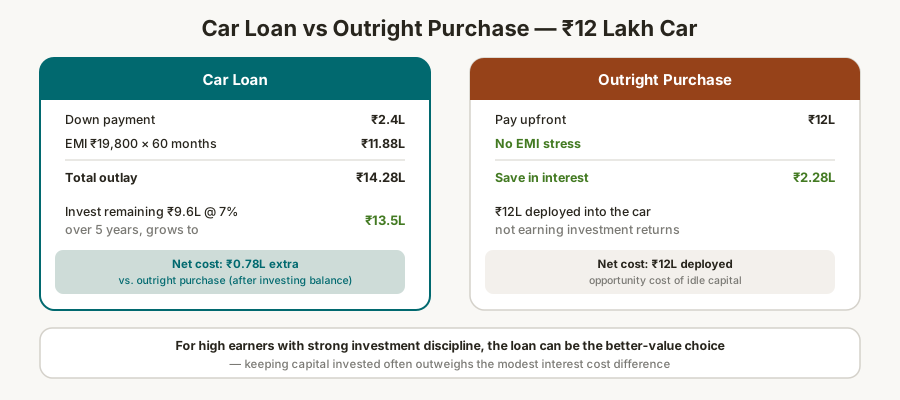
Car Loan Rates in India 2026: What You'll Actually Pay
Car loan rates in India in 2026 range from 8.5% to 12%+, depending on the lender and your profile. But there's a critical caveat that dealerships and some NBFCs frequently obscure:
Many car loans use flat rates, not reducing balance rates.
A dealer finance offer of "9% flat" translates to approximately 16.5–17% effective (reducing balance) rate. This is a significant difference that changes the entire loan-vs-cash calculation. Before any comparison, confirm whether your rate quote is flat or reducing balance.
Car loan rates by lender type (June 2026)
| Lender | Rate | Basis | Effective Rate |
|---|---|---|---|
| SBI Car Loan | 8.65–9.45% | Reducing balance | 8.65–9.45% |
| HDFC Bank | 8.75–9.75% | Reducing balance | 8.75–9.75% |
| ICICI Bank | 8.80–9.90% | Reducing balance | 8.80–9.90% |
| Axis Bank | 8.75–10.25% | Reducing balance | 8.75–10.25% |
| HDFC Bank via dealer | "7% flat" (ex) | Flat | ~12.8% effective |
| Dealer NBFC financing | "8% flat" (ex) | Flat | ~14.7% effective |
Always get a sanction letter from a bank before visiting the showroom. Dealers earn significant commissions from steering customers toward their preferred finance arm, which is rarely the cheapest option. Use our loan comparison tool to put bank and dealer finance options side by side before you sign.
The Complete Cost of a Car Loan
For a ₹10 lakh car, 20% down payment, ₹8 lakh loan, 9% reducing balance, 5-year tenure (use our car loan EMI calculator to run your own numbers):
| Component | Amount |
|---|---|
| Down payment | ₹2,00,000 |
| Loan amount | ₹8,00,000 |
| Monthly EMI (5 years, 9%) | ₹16,607 |
| Total EMI paid | ₹9,96,420 |
| Total interest paid | ₹1,96,420 |
| Total cost of the car (loan path) | ₹11,96,420 |
The loan costs you ₹1,96,420 extra over 5 years — essentially 24.5% of the original ₹8 lakh loan amount.
The Cash Purchase Alternative
If you have ₹10 lakh and pay outright, you avoid ₹1,96,420 in interest. But you also forfeit the investment return you could have earned on that ₹10 lakh.
Opportunity cost at different return rates:
| Investment Return | Value of ₹10L after 5 years |
|---|---|
| 7% (debt fund / FD) | ₹14.03 lakh |
| 10% (balanced mutual fund) | ₹16.11 lakh |
| 12% (equity fund) | ₹17.62 lakh |
If that ₹10 lakh earns 12% over 5 years, the opportunity cost of deploying it in the car is ₹7.62 lakh in foregone returns — far more than the ₹1.96 lakh in loan interest saved.
At this surface level, the loan appears to win.
But wait.
Why the Car Loan Analysis Is Different from a Home Loan
1. Cars are depreciating assets
A home has some probability of appreciating. A car is guaranteed to lose value. The ₹10 lakh car is worth approximately:
- ₹8 lakh after Year 1 (20% depreciation)
- ₹6 lakh after Year 2
- ₹4.5 lakh after Year 3
- ₹3.5 lakh after Year 4
- ₹2.8 lakh after Year 5
By the time you've paid off a 5-year car loan, the car is worth roughly 28% of what you paid for it. This depreciation is the dominant financial variable — far larger than the interest cost or opportunity cost.
This doesn't mean you shouldn't buy the car. You need transportation. But it does mean that the financial case for leverage on a depreciating asset is fundamentally weaker than leverage on a potentially appreciating asset.
2. Comprehensive insurance is mandatory — and linked to car value
Lenders require comprehensive insurance for the duration of the loan. Insurance premiums are based on IDV (Insured Declared Value), which tracks the depreciating market value. A ₹10 lakh car:
- Year 1 comprehensive premium: ₹25,000–₹40,000
- Year 5 comprehensive premium: ₹10,000–₹18,000
These costs are incurred regardless of loan vs. cash, so they don't affect the comparison directly — but they're part of the true cost of car ownership.
3. Flat rate trap at dealerships
The dealership's "8% flat" rate on a 5-year loan is equivalent to ~14.7% reducing balance. At this rate, the loan costs ₹3.34 lakh in interest over 5 years — significantly changing the calculation.
If you're buying at dealership rates without negotiating, the cash purchase wins.
The Decision Framework
When taking a car loan makes sense:
- You're getting a genuine bank loan at 9% reducing balance or below
- The cash you're preserving is genuinely invested in equity (10%+ target return)
- You are disciplined enough to invest the freed cash immediately and consistently
- You have a surplus of cash and don't need to liquidate savings to buy outright
When buying outright makes more sense:
- You're being offered dealership/NBFC financing at "flat rates" that translate to 13%+
- You don't have investment discipline — the freed cash will sit in a savings account (3.5% return) rather than being invested
- You want to avoid the debt commitment, insurance mandate, and monthly EMI
- You're buying a second-hand car where financing options are limited and rates are higher
- Your CIBIL score is below 750 — you'll pay a risk premium that makes the loan more expensive
The Second-Hand Car Exception
Financing a second-hand car is almost never mathematically attractive:
- Rates are 1–3% higher (11–12% reducing balance from good lenders)
- Tenure is shorter (3 years max for older cars)
- The car depreciates faster from a lower base value
- You're paying premium interest on an already-depreciated asset
If you're buying second-hand, cash purchase is the clear financial preference.
Using Our Calculator
Use our car loan EMI calculator to compute your exact EMI and total interest cost. Enter both the dealer's quoted flat rate and the bank's reducing balance rate to see the actual difference. The calculation will show you exactly how much the loan costs so you can make a direct comparison with your opportunity cost.
Frequently Asked Questions
Is it better to buy a car with a loan or cash in India?
If you're getting a genuine bank rate (9% reducing balance or below) and your saved cash is invested in equity (10%+ expected return), a loan is marginally better mathematically. But the simplicity, freedom from EMI commitment, and avoidance of flat-rate traps at dealerships makes cash purchase attractive for most buyers who have the funds.
What is the current car loan interest rate in India in 2026?
Major banks offer 8.65–9.90% on reducing balance basis for new cars to prime borrowers (CIBIL 750+). Dealer finance arms and NBFCs often quote flat rates of 7–9%, which translate to 13–17% effective rates. Always compare on a reducing balance basis.
Do car loan interest rates differ for new vs used cars?
Yes. New car loans are offered at 8.65–10.25% (reducing balance) at major banks. Used car loans are 1.5–3% higher (10–13.5%) with shorter maximum tenures (3–5 years depending on vehicle age). Financing a used car over 5 years old is rarely possible through mainstream lenders.
Is there a tax benefit on car loan interest in India?
No, for personal vehicles. Interest on car loans for personal use is not tax-deductible. If the vehicle is used for business, interest may be claimed as a business expense — consult a CA for your specific situation.
What down payment is required for a car loan?
Most lenders require 10–20% down payment (financing up to 80–90% of the ex-showroom price). Some lenders offer 100% financing for top credit profiles, but this results in a higher EMI and greater total interest outflow. A 20–25% down payment is the practical sweet spot. For a worked example on a specific model — including road tax and the full on-road price by state — see our Toyota Fortuner EMI and on-road price guide.
Can I foreclose a car loan early? Is there a penalty?
Most banks allow foreclosure after 6–12 months. Unlike home loans (where RBI bans prepayment penalties for floating rate), car loans are typically fixed-rate, so lenders can charge a foreclosure fee of 2–4% of the outstanding amount. Use our prepayment calculator to check whether the interest saved justifies the penalty before foreclosing early.
Try the calculator
Run your own numbers in seconds. Pick the calculator that fits your loan type.